TL;DR: AI is reshaping how software is built, but industry is absent from the conversation about how we teach the next generation of engineers-—-and salesmanship is making it harder for educators to separate real uses of AI from hype. SIGCSE 2026 made clear that industry must show up, be honest about what AI actually solves, and help CS education shift from testing mechanical code production to assessing the creative, essential complexities that can’t be automated.
Hit the spacebar enough and cocaine comes out / I really like this computer!
- Dismemberment Plan, No One’s Saying Nothing
40 years ago, Fred Brooks wrote about accidental complexities and essential complexities in software engineering, arguing that there was No Silver Bullet for the essential complexity, and what was true 40 years ago is still true today.
Software engineering is hard. At its core is the construction of complex and reliable systems from simple and unreliable components. This construction is fraught with complexities—complexities that some hope AI will solve.
The reality is that generative AI and LLMs excel at solving our accidental complexities: the overhead of syntax, connecting systems, aggregating disparate data sources, etc. They do not—and likely never will—solve our essential complexities. For nontrivial problems, what to build is the hard part, and the part that requires the computer scientist and deep computer science thinking. Coding is just the mechanical translation of these specs and corresponding mental models.
There is no silver bullet for solving the essential complexity, at least no silver bullet that comes from the statistical correlation of symbols in human-produced text.
This distinction was missing from SIGCSE2026.
SIGCSE 2026 was bad 
I have to admit that I wrote most of this article while the Saturday morning sessions were happening. I missed Titus Winters’s EXCELLENT keynote that reinforces most of what I’ve written here.
In fact, it was the worst SIGCSE that I have been to. I didn’t come away from SIGCSE with a whole lot to think about, other than this article. I attended (or heard reports from friends about) many, many, many sessions about AI, but I didn’t hear any particularly good talks, other than a few that were in partnership with industry.
Why?
A crisis of ambiguity 
Generally, the EDU community does not know how to think about or how to respond to generative AI. On the one hand, this feels natural—we’re sharing how we’re figuring things out and evolving a shared understanding and future. However, the technology is still very early, and it seems like EDU is finding it very difficult to differentiate signal from noise.
This is compounded by the fact that we in industry are generally having difficulty with this differentiation. Conversations about AI have conflated two very different things:
-
The very powerful uses within the SDLC: Coding agents and modern models are revolutionizing software construction—in every phase of the lifecycle. Outside of code generation, other uses are arguably more impactful on how we will do our jobs in the future; usages that connect systems, synthesize information from disparate sources, or provide adaptive natural interfaces to ill-defined or missing API surfaces. These are the killer use cases for me and where I have found benefit in my day-to-day.
-
The very loud and very chaotic hype surrounding AI and AI investment, and corresponding AI-infusion and sales of AI-infused products. Conversations around eliminating white collar entry-level jobs, automating professions, eliminating creatives, “agentic employees,” etc. are hyperbolic, unrealistic, and driving an economic bubble and an unrealistic, inhumane, and fundamentally capitalist view of the future.
The real benefits of AI—the actual usages that are economically and environmentally sustainable, have provable positive impact, and provide real efficiency wins—are drowned in a sea of capitalistic idealism that is fundamentally alienating to a humanist perspective of the world.
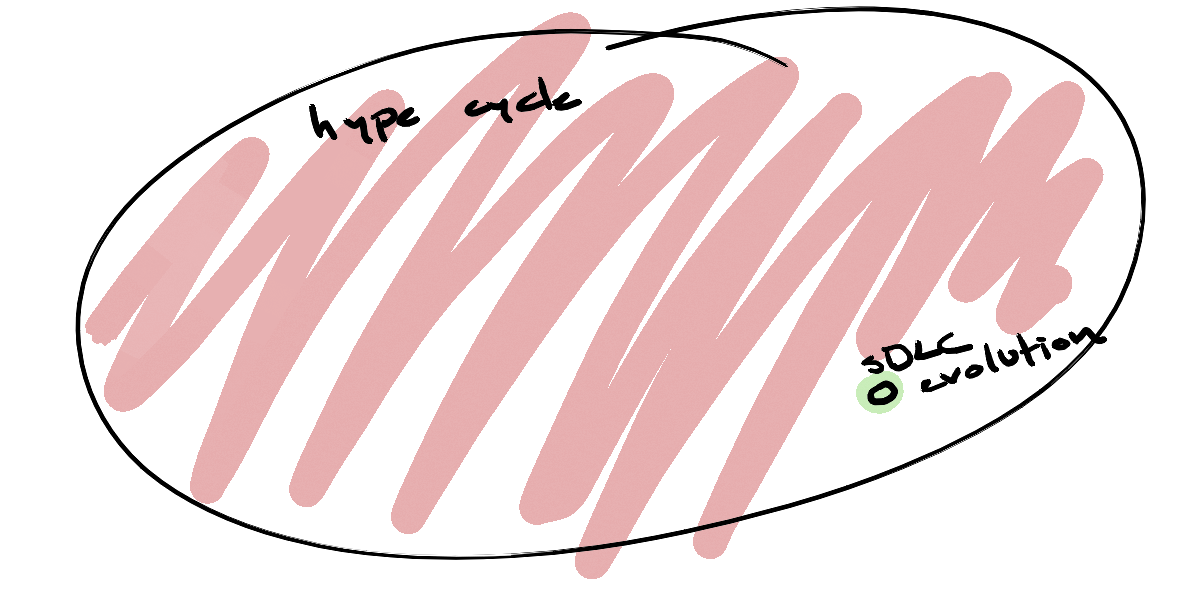
Unfortunately, though, I feel like there is very little separation between these conversations, and industry is the culprit.
Industry is selling solutions to essential complexity, but is only realistically solving the accidental complexities. This is not to say that things aren’t changing, though.
We are at a tooling inflection point. The mechanical day-to-day of software construction is changing and will continue to change dramatically. There are real, impactful tools being developed that will change software forever.
Generally, most software engineers that I know have begun to understand this and embrace generative AI. However, they are embracing generative AI where it makes them more efficient, reduces cognitive load, or makes automation a much lower investment. With agentic coding and construction of “disposable software,” automation is now often worth the effort of describing the problem and desired scripts/tools to an agent.
This is entirely in contrast to how most AI companies have been positioning their products: as silver bullets for efficiency, allowing CTOs and CEOs to create redundancy in their most specialized roles and replace expensive people with automation. This sort of “disposable” approach to software is killing reliability globally.
Reliable systems are not vibe coded, nor are they disposable.
We see this now with Amazon, which reportedly having a reliability crisis brought on by flakiness of AI-generated code.
A crisis of identity 
At the heart of this disconnect in education is a fundamental misunderstanding of our identity as computer scientists and software engineers.
Computer science has long been considered a branch of applied mathematics, a specialization in the subdiscipline of information processes. While true, this disciplinary identity is disconnected from the work of most computer scientists.
We do not act as mathematicians studying processes in isolation; we act upon the world through the construction of real-world systems. Building software is a creative act.
As a practitioner, the challenge (and excitement) of my work is in my creative application of critical, structured thinking to ambiguous and informally specified problems. Our first act is one of refinement: of formalizing a problem into a precise definition. Our second act is to translate this precise definition into a software system.
Computer scientists have often noted this. 50 years ago Dijkstra made the statement that computer science is no more about computers than astronomy is about telescopes. 15 years ago Jeanette Wing called back to Dijkstra in her description of and advocacy of computational thinking. CS Principles and other “unplugged” curricula have continued this thread of thought.
However, changes in undergraduate education have lagged behind. This lag is rooted in our identities. We consider ourselves, often, as applied mathematicians, or at least “scientists” or “engineers.”
This sort of self-characterization breeds an obsession with formality, precision, and objective assessment—and an obsession with programming as the fundamental skill we teach our students. Programming is a process of translation, and the most mechanical work that we do—perhaps the most accidental complexity.
If we are honest with ourselves about our work—either as researchers or as practitioners—we are creatives. We are not so different from designers, artists, or marketers—those of our peers whose job is to translate abstract concepts and objectives into novel and strategic artifacts that interpret and communicate these objectives. This translation is not mechanical and requires expertise, judgment, and creativity. This is the essential complexity of our work.
Embracing a creative identity 
Why are student assignments so easy with AI? It’s our fault, we’ve trivialized them, and we assess the wrong things. We do the hard work for them: we generate the precise specification and assess only the mechanical translation. This is the exact skill that AI does best!
What we really want to do is assess the problem-solving skills: those skills of refinement and specification. We want to see the ideas behind the algorithm, but our assignments are so scaffolded so as to constrain creativity in the design of that algorithm, making it an almost-meaningless exercise.
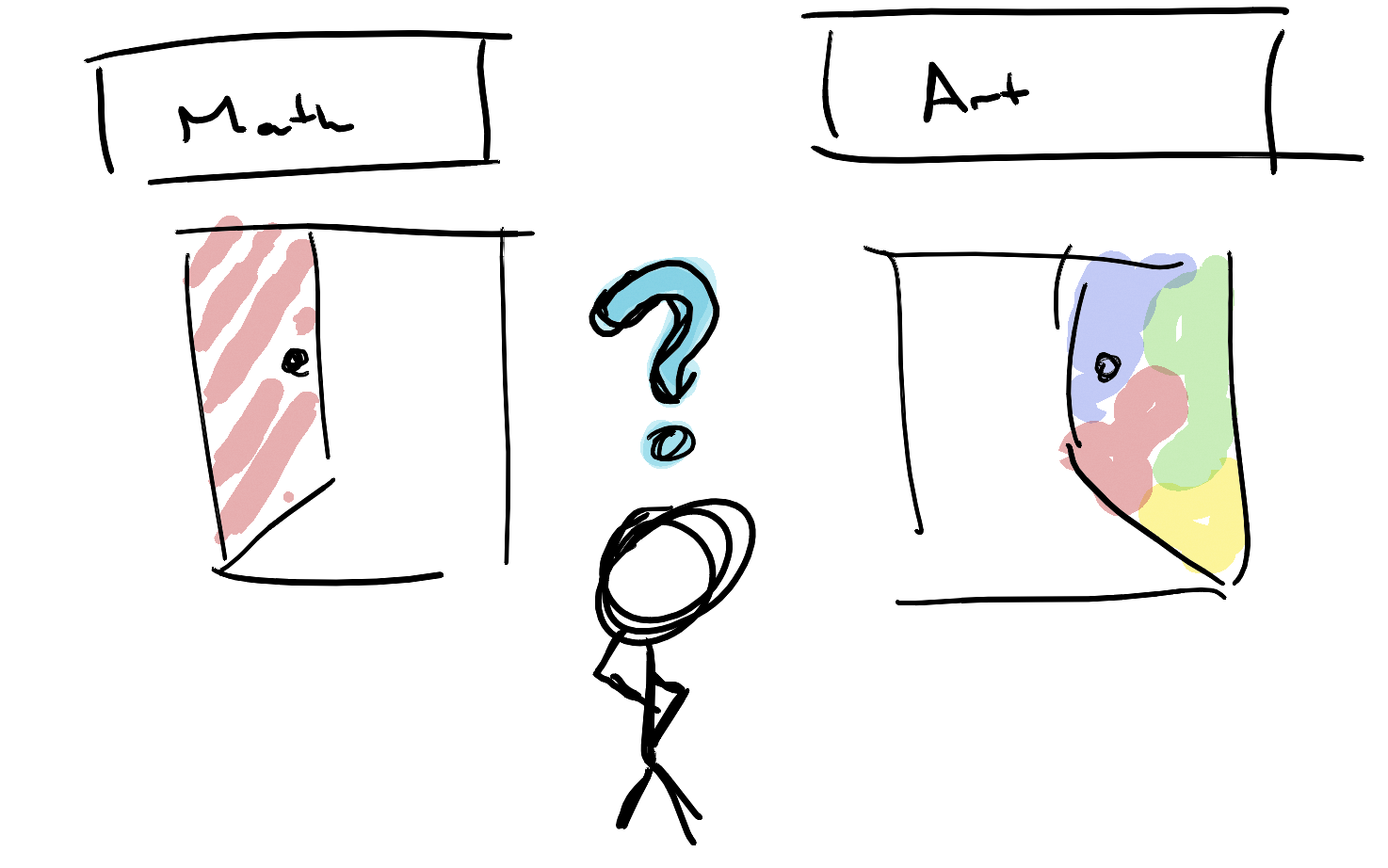
What does it look like to shift the way that we think about what we want to assess? This looks like loosening our focus on the medium of programming and more on the process skills that undergird programming. Spending more time talking about specification and refinement, more time talking about type theory, more time talking about semantic execution models, and more time talking.
Our process skills are not mechanical or objective, they are creative and subjective. We can shift our assessment left in the development process, we can give students more freedom in their specifications, and more freedom in the design of the objects that they create.
This shift in identity means a shift in how we scale ourselves. Art faculty limit class sizes, embrace peer review, and critique. We will need to do so as well. We need to be closer to our students’ minds, not the mathematical objects that they produce. We need to understand how they approach the essential ideas of the discipline, not how they produce artifacts and how well they tackle the accidental complexity of that production.
Industry needs to be more present 
Our companies are selling AI to the tune of billions of new revenue generated overnight. The economic landscape of the United States is AI-centric, and all-in on an unproven technology in the general case. In industry, we need to be honest with our academic peers. We have to be very clear about what is working for us and what isn’t. Our salesmanship harms our academic peers’ ability to reason clearly about AI.
In fact, we should be helping our academic peers shift their thinking toward what we are valuing in industry: a strong foundation in the fundamentals, the people and communication skills necessary to interface with others and teams, and clear structured thinking about tradeoffs and strategy.
And we should be making it clear where AI is helpful and where it isn’t. We are the ones who are revolutionizing the SDLC. Let’s bring them along with us, but bring them along where AI is working for us. Right now they are figuring it out for themselves and are flailing. The only AI-related talks that I heard that were any good at SIGCSE came out of industry partnerships. We need to do more here globally across the industry.
GitHub was at SIGCSE, but where were Anthropic and Claude at SIGCSE? Where was Cursor? Other major players? These tools want to revolutionize software construction without meaningfully engaging with the source of our students’ intellectual development as computer scientists.
Industry is the hinge, and it needs to be more present.
Back to the essence 
Central to Brooks’s thesis is that the essential complexities of software are what to build, how, and by whom. These are the problems of design and creative acts. As Brooks argues in his closing, constructing software is about people. Growing those people into a AI-enabled future requires collaboration.
Industry needs to be in a tighter loop here and to support EDU in teaching generative AI for software engineering. The distinction between real use and salesmanship has to be clear to educators and to students. Industry must partner outside of large research institutions and researchers that advance industry state-of-the-art and engage with people teaching computer science to most students in the US. Industry needs to be in the conversation, or our talent pools will age out.